Whelth Research · Med Spas · September 2026
The State of America's Med Spas — 2026
What 14,748 U.S. med spas actually sell — and how far the category has moved from Botox into prescription medicine.
Key findings
- Of 14,748 U.S. med spas whose published service menus Whelth Research reviewed, 57.3% (8,444) list at least one medical intervention — most commonly a prescription weight-loss program, IV/NAD+ infusions, hormone therapy or peptides; the full twelve-service definition is under Definitions — alongside, or instead of, aesthetic treatments. #
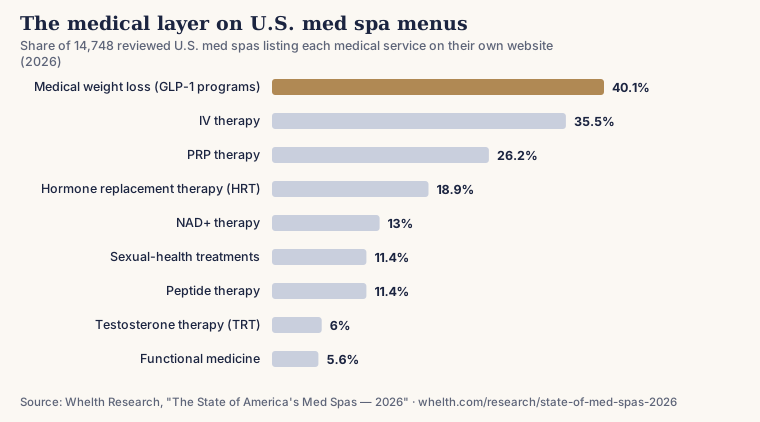
- 40.1% of reviewed med spas (5,913) list a medical weight-loss program, a category that in this market is predominantly GLP-1 prescribing (semaglutide, tirzepatide). More med spas list weight loss than list lip fillers (30.2%), Sculptra (35.1%) or CoolSculpting (9.6%). #
- Weight loss is the med spa's sixth most common service overall, behind Botox (72.9%), microneedling (71.9%), chemical peels (63.7%), dermal fillers (61.6%) and laser hair removal (52.8%) — and ahead of every other aesthetic treatment on the menu. #
- 38.3% list IV or NAD+ therapy, 21% list hormone therapy (HRT, TRT or thyroid optimization) and 11.4% list peptide therapy — the compounded category the FDA moved to restrict in 2023–24. #
- Testing rarely comes with the prescription: only 8.6% of reviewed med spas list any diagnostic service and 4.2% list blood testing. Of the 8,444 med spas selling a medical intervention, 93.1% list no blood-testing service on their published menu and 86% list no diagnostic service of any kind. #
- Of the 5,913 med spas listing a weight-loss program, 92.2% list no blood-testing service; of the 3,100 listing hormone therapy, 86.6%. #
- The drift is a med-spa phenomenon more than an aesthetics one: among 4,699 aesthetic medical practices (plastic surgery and dermatology), 20.6% list weight loss and 9.4% hormone therapy, versus 40.1% and 21% of med spas. A med spa is roughly twice as likely as a plastic surgeon to sell weight-loss drugs. #
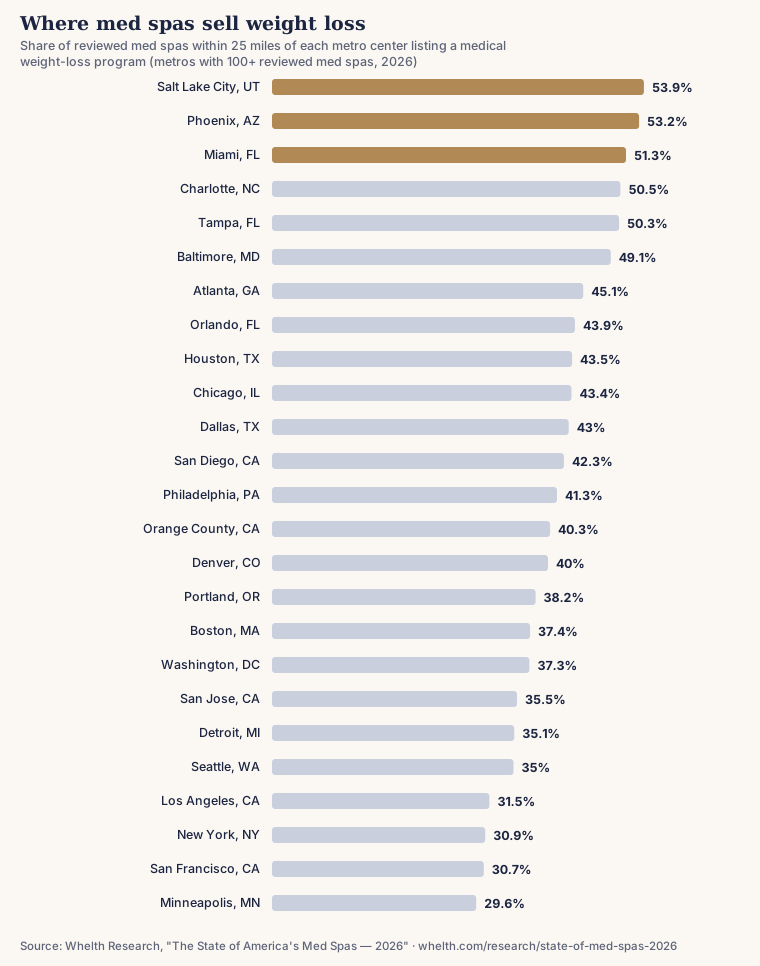
- Among states with 100+ reviewed med spas, Utah (48.6%), Florida (48.5%), Arkansas (48.4%) and Arizona (48.1%) have the highest share of med spas selling weight loss; Mississippi (25%), Alabama (29.5%) and New York (31.1%) the lowest. Among metros with 100+ reviewed med spas, Salt Lake City (53.9%), Phoenix (53.2%), Miami (51.3%) and Charlotte (50.5%) lead; Minneapolis (29.6%), San Francisco (30.7%) and New York (30.9%) trail. #
Summary
The med spa was built on a short menu: neuromodulators, fillers, lasers, peels. Whelth Research reviewed the published service menus of 14,748 U.S. med spas across 51 states and 3,002 cities — each service recorded with a verbatim excerpt from the practice's own website — and found the menu has changed. 57.3% now list at least one medical intervention. The largest single addition is prescription weight loss, listed by 40.1% of med spas reviewed; IV and NAD+ infusions follow at 38.3%, hormone therapy at 21%, peptides at 11.4%.
What has not followed is measurement. Only 8.6% of reviewed med spas list any diagnostic service and 4.2% list blood testing, so 93.1% of the med spas selling a medical intervention show no blood-testing service on the menu that sells it. The move is national — in every state with 100 or more reviewed med spas, at least one in four lists weight loss — and what varies is how far it has gone: from 25% of reviewed med spas in Mississippi to 48.6% in Utah.
Definitions
A service counts only when the practice's own website evidences it (captured verbatim at review time). Categories used in this report:
| Reviewed med spa | a practice classified as a med spa in Whelth's directory with at least one service evidenced on its own website (n = 14,748) |
| Medical intervention | medical weight loss (GLP-1 programs), hormone replacement therapy (HRT), testosterone therapy (TRT), thyroid optimization, peptide therapy, IV therapy, NAD+ therapy, sexual-health treatments, hyperbaric oxygen, ozone therapy, stem-cell therapy, ketamine therapy |
| Hormone therapy | HRT, TRT, thyroid optimization |
| Diagnostic (any) | blood testing / lab panels, biomarker panels, genetic testing, DEXA, body composition analysis, VO₂ max testing, continuous glucose monitoring, coronary calcium scoring, multi-cancer early detection, full-body MRI, clinical sleep studies |
| Blood testing | blood testing / lab panels, biomarker panels |
| Share | a percentage of the med spas reviewed (or of the sellers named in the row) — never an estimate of all U.S. med spas |
The aesthetic core
The traditional menu is intact. Neuromodulators and microneedling are each listed by more than seven in ten med spas reviewed; peels, fillers and laser hair removal by more than half.
| Service | Med spas listing it | Share of reviewed |
|---|---|---|
| Botox & neuromodulators | 10,754 | 72.9% |
| Microneedling | 10,607 | 71.9% |
| Chemical peels | 9,395 | 63.7% |
| Dermal fillers | 9,090 | 61.6% |
| Laser hair removal | 7,789 | 52.8% |
| Sculptra | 5,180 | 35.1% |
| Lip fillers | 4,452 | 30.2% |
| Laser skin resurfacing | 3,179 | 21.6% |
| Kybella | 3,164 | 21.5% |
| Thread lift | 2,277 | 15.4% |
| PRF treatment | 1,479 | 10.0% |
| CoolSculpting | 1,418 | 9.6% |
The medical layer
Beneath the aesthetic menu, most med spas reviewed now sell medicine. Weight loss is the largest addition and is listed by more med spas than any aesthetic service outside the top five.
| Service | Med spas listing it | Share of reviewed |
|---|---|---|
| Medical weight loss (GLP-1 programs) | 5,913 | 40.1% |
| IV therapy | 5,240 | 35.5% |
| PRP therapy | 3,861 | 26.2% |
| Hormone replacement therapy (HRT) | 2,790 | 18.9% |
| NAD+ therapy | 1,917 | 13.0% |
| Sexual-health treatments | 1,688 | 11.4% |
| Peptide therapy | 1,686 | 11.4% |
| Testosterone therapy (TRT) | 888 | 6.0% |
| Functional medicine | 825 | 5.6% |
| Body composition analysis | 654 | 4.4% |
| Blood testing / lab panels | 603 | 4.1% |
| Hyperbaric oxygen | 245 | 1.7% |
57.3% of med spas reviewed list at least one medical intervention (8,444 practices). Nearly all of them still sell the original product: 84.6% of the med spas listing a medical intervention also list Botox. The medical layer is an addition to the aesthetic menu, not a replacement for it.
| Practice type | n | Weight loss | Hormone therapy | IV / NAD+ | Any medical intervention |
|---|---|---|---|---|---|
| Med spa | 14,748 | 40.1% | 21.0% | 38.3% | 57.3% |
| Plastic surgery / dermatology practice | 4,699 | 20.6% | 9.4% | 9.9% | 29.7% |
The comparison shows where the drift lives. A plastic-surgery or dermatology practice is far less likely to have added weight-loss drugs (20.6%) or hormones (9.4%) to its menu than a med spa (40.1% and 21%). The med spa — a retail-format business typically run by nurse injectors under a medical director — has become the main storefront for prescription weight loss in aesthetic medicine.
Sold without testing
GLP-1 prescribing, hormone therapy and peptide protocols are built on laboratory values. On med spa menus, the laboratory is mostly absent.
| Group | Med spas | List no blood testing | List no diagnostic at all |
|---|---|---|---|
| All reviewed med spas | 14,748 | 95.8% | 91.4% |
| Selling any medical intervention | 8,444 | 93.1% | 86.0% |
| Selling medical weight loss | 5,913 | 92.2% | — |
| Selling hormone therapy | 3,100 | 86.6% | — |
| Selling peptide therapy | 1,686 | 87.1% | — |
Of the 5,913 med spas reviewed that sell a weight-loss program, 92.2% list no blood-testing service on their published menu; of the 3,100 selling hormone therapy, 86.6%. These are higher than the figures in Whelth Research's Sold, Not Measured brief (55.4% of med spas selling longevity interventions listed no blood testing) because that brief counted only med spas that qualified as longevity practices — which by definition evidence a diagnostic or a broader longevity menu. This report covers every med spa reviewed, and the wider the lens, the thinner the testing.
By state
States with at least 100 reviewed med spas, ranked by the share listing a weight-loss program. Counts are the number of med spas reviewed in each state, not the number that exist (see Methodology); the shares are the finding.
| State | Reviewed med spas | Weight loss | Hormone therapy | Any medical intervention |
|---|---|---|---|---|
| Utah | 245 | 48.6% | 35.9% | 62.4% |
| Florida | 1,278 | 48.5% | 26.7% | 65.9% |
| Arkansas | 128 | 48.4% | 32.0% | 70.3% |
| Arizona | 366 | 48.1% | 31.1% | 65.6% |
| Kansas | 109 | 47.7% | 33.0% | 57.8% |
| Louisiana | 170 | 47.1% | 28.8% | 62.4% |
| Oklahoma | 141 | 46.8% | 34.0% | 66.0% |
| Maryland | 278 | 46.4% | 20.1% | 59.0% |
| Missouri | 192 | 46.4% | 29.2% | 64.6% |
| Texas | 1,124 | 45.8% | 23.5% | 60.1% |
| Kentucky | 170 | 45.3% | 34.1% | 68.2% |
| New Mexico | 104 | 45.2% | 32.7% | 65.4% |
| Nevada | 120 | 45.0% | 21.7% | 65.0% |
| North Carolina | 377 | 43.5% | 24.9% | 59.9% |
| Ohio | 394 | 43.4% | 23.4% | 56.9% |
| Georgia | 403 | 43.2% | 23.1% | 57.6% |
| Illinois | 507 | 42.2% | 19.7% | 57.2% |
| Colorado | 350 | 41.1% | 24.3% | 57.4% |
| Tennessee | 296 | 40.5% | 29.1% | 60.8% |
| Idaho | 133 | 39.1% | 19.5% | 60.9% |
| Virginia | 374 | 38.8% | 23.0% | 49.2% |
| Oregon | 215 | 38.1% | 14.0% | 52.1% |
| Wisconsin | 224 | 37.9% | 16.1% | 49.1% |
| Connecticut | 196 | 37.2% | 17.3% | 54.6% |
| New Jersey | 410 | 36.6% | 15.4% | 53.2% |
| Indiana | 235 | 36.6% | 22.6% | 53.2% |
| Washington | 407 | 35.9% | 16.2% | 50.6% |
| California | 2,013 | 35.8% | 14.1% | 56.4% |
| Massachusetts | 498 | 34.9% | 13.5% | 51.4% |
| Iowa | 133 | 34.6% | 19.5% | 52.6% |
| South Carolina | 172 | 34.3% | 23.3% | 54.7% |
| Minnesota | 252 | 33.3% | 14.7% | 46.8% |
| Pennsylvania | 240 | 33.3% | 17.1% | 54.2% |
| Michigan | 344 | 32.3% | 11.3% | 52.9% |
| New York | 753 | 31.1% | 12.9% | 49.4% |
| Alabama | 132 | 29.5% | 23.5% | 41.7% |
| Mississippi | 100 | 25.0% | 25.0% | 49.0% |
Utah (48.6%), Florida (48.5%), Arkansas (48.4%) and Arizona (48.1%) have the highest share of med spas selling weight loss; Mississippi (25%), Alabama (29.5%) and New York (31.1%) the lowest. Hormone therapy follows a similar map — Utah (35.9%), Kentucky (34.1%) and Oklahoma (34%) at the top; Michigan (11.3%), New York (12.9%) and Massachusetts (13.5%) at the bottom. The two most populous states sit on opposite sides: 48.5% of Florida's reviewed med spas sell weight loss against 35.8% of California's.
By metro
Reviewed med spas within 25 miles of each metro center, for the 34 metros where Whelth publishes a med spa directory. Each metro name links to its directory page.
| Metro | Reviewed med spas (25 mi) | Weight loss | Any medical intervention |
|---|---|---|---|
| Kansas City, MO | 69 | 56.5% | 68.1% |
| Salt Lake City, UT | 141 | 53.9% | 69.5% |
| Phoenix, AZ | 201 | 53.2% | 70.1% |
| Raleigh, NC | 77 | 53.2% | 63.6% |
| Miami, FL | 267 | 51.3% | 70.4% |
| Charlotte, NC | 107 | 50.5% | 68.2% |
| Tampa, FL | 193 | 50.3% | 68.9% |
| Austin, TX | 59 | 49.2% | 54.2% |
| Baltimore, MD | 163 | 49.1% | 61.3% |
| Las Vegas, NV | 72 | 47.2% | 69.4% |
| Columbus, OH | 82 | 46.3% | 59.8% |
| St. Louis, MO | 94 | 45.7% | 66.0% |
| Atlanta, GA | 175 | 45.1% | 59.4% |
| Orlando, FL | 155 | 43.9% | 62.6% |
| Houston, TX | 170 | 43.5% | 64.7% |
| Chicago, IL | 249 | 43.4% | 57.0% |
| Dallas, TX | 263 | 43.0% | 57.0% |
| San Diego, CA | 104 | 42.3% | 60.6% |
| Philadelphia, PA | 104 | 41.3% | 59.6% |
| Orange County, CA | 380 | 40.3% | 63.9% |
| Denver, CO | 205 | 40.0% | 59.0% |
| Sacramento, CA | 97 | 39.2% | 53.6% |
| Portland, OR | 131 | 38.2% | 52.7% |
| Boston, MA | 326 | 37.4% | 53.7% |
| Washington, DC | 263 | 37.3% | 48.3% |
| Nashville, TN | 69 | 36.2% | 59.4% |
| San Jose, CA | 141 | 35.5% | 49.6% |
| Detroit, MI | 202 | 35.1% | 55.0% |
| Seattle, WA | 177 | 35.0% | 52.0% |
| Los Angeles, CA | 480 | 31.5% | 57.5% |
| New York, NY | 634 | 30.9% | 49.1% |
| San Francisco, CA | 179 | 30.7% | 52.0% |
| Minneapolis, MN | 189 | 29.6% | 43.9% |
| Pittsburgh, PA | 44 | 22.7% | 47.7% |
Weight loss on the med spa menu is a Sun Belt and Mountain West phenomenon. Salt Lake City (53.9%), Phoenix (53.2%), Miami (51.3%), Charlotte (50.5%) and Tampa (50.3%) lead the metros with 100 or more reviewed med spas; the coastal capitals of aesthetic medicine trail — New York (30.9%), Los Angeles (31.5%), San Francisco (30.7%) — with Minneapolis (29.6%) lowest of all.
Methodology
Population and dates. The 14,748 practices are every med spa in Whelth's directory as of 11 September 2026 that is classified as a med spa, is live, and has at least one service evidenced on its own website (15,061 med-spa records were live; the difference is unenriched discovery shells). Med spas were discovered through Google Places searches for "med spa" in each of the 2,003 U.S. cities of 25,000 or more people plus earlier metro-by-metro acquisition, then each practice's website was crawled (home page plus up to seven linked service and team pages) and services were matched against Whelth's aesthetic and longevity service vocabularies. Every one of the 108,544 service records carries the source URL, and 108,227 carry a verbatim excerpt from the page; the reviewed med spas list 7.4 services on average. The websites were read between 18 July and 7 September 2026 — 98% of them on 24–25 July, with 232 practices re-read in August and September — and every statistic was computed from that stored evidence on 11 September 2026. A menu can change between the day it was read and the day you read this; the collection window, not the computation date, is the date of the observations.
Why this report publishes shares, not counts. The discovery sweep returned at most 20 results per city (18,893 places across 2,003 cities), so dense metros are under-counted relative to small cities: the numbers of reviewed med spas in New York or Los Angeles are floors, not counts. For that reason this report publishes no per-capita density, no ranking of cities by number of med spas, and no estimate of how many med spas the United States has. Shares — the percentage of reviewed med spas listing a service — do not depend on having found every med spa, though they do reflect the practices Google Places ranks most prominently for "med spa" in each city, which likely favours larger and better-reviewed businesses.
Classification. Each practice's evidenced services were mapped to the aesthetic, medical-intervention, hormone, diagnostic and blood-testing sets defined above. State rows count a practice once, at its primary location, and include states with at least 100 reviewed med spas. Metro rows count reviewed med spas whose primary location lies within 25 miles of the metro's downtown coordinates. The aesthetic medical practices in Table 3 are physician practices in Whelth's aesthetics directory with at least one evidenced service.
Limitations. The analysis sees what a practice publishes. Blood testing is recognised from the terms "blood testing", "blood work", "blood panel", "blood test" and "biomarker panel"; a practice that requires labs but describes them only as "lab work" on a page the crawl did not reach, or orders them through an outside laboratory without listing testing at all, counts as listing none. The testing figures therefore describe published menus, not clinical conduct, and are reported only as shares of a category. Nothing here characterises any individual practice. All figures describe the collection window above and will be refreshed at this URL.
Whelth Research. (2026). The State of America's Med Spas — 2026. WHELTH. https://whelth.com/research/state-of-med-spas-2026