Whelth Research · Data brief · September 2026
Sold, Not Measured
How often U.S. longevity clinics prescribe without testing — a data brief from the 2026 national census of longevity medicine.
Key findings
- Of 3,549 U.S. practices offering longevity medicine, 31% (1,100) list at least one intervention — hormones, peptides, IV/NAD+ or similar — and no diagnostic service of any kind, not even blood testing, on their published service menu. #
- Of the 2,149 practices selling hormone therapy (HRT or TRT), 86.9% list none of the seven measurements longevity medicine is named for (DEXA, VO₂ max, CGM, coronary calcium score, multi-cancer early detection, full-body MRI, sleep study). #
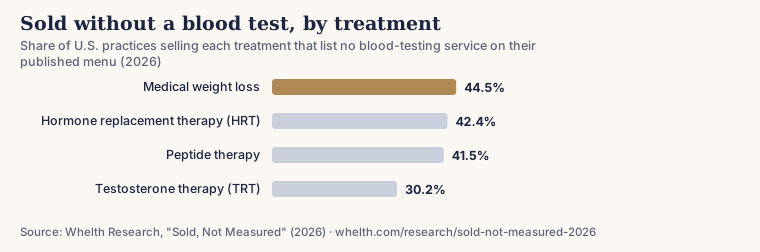
- Of 857 practices selling testosterone therapy, 30.2% list no blood-testing service; of 1,100 selling peptide therapy, 41.5%; of 2,237 offering medical weight loss, 44.5%. #
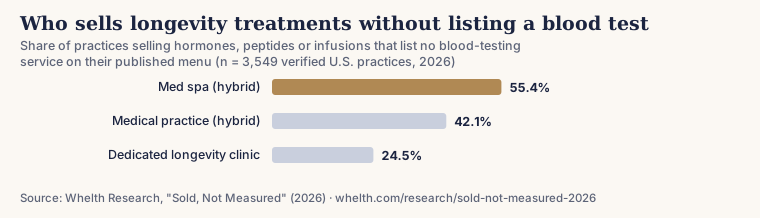
- 55.4% of med spas selling longevity interventions list no blood-testing service, versus 42.1% of medical practices and 24.5% of dedicated longevity clinics. Med spas are 52.6% of all such sellers nationally. #
- Only 13.4% of all longevity practices list any frontier measurement; among dedicated longevity clinics, 27.1%. #
- Among states with 40+ verified practices, Maryland (45.7%), Kentucky (37.3%) and Oregon (37%) have the highest share of practices selling with no diagnostic listed; Kansas (10.9%), Massachusetts (16.4%) and Nevada (19.2%) the lowest. #
- A verified longevity practice is seven times more likely to list Botox (38%) than a DEXA scan (5.3%); 9.1% list ozone therapy, which FDA regulation 21 CFR 801.415 describes as having "no known useful medical application." #
Summary
Longevity medicine's premise is measurement first: know the biomarkers, then intervene. Whelth Research's national census verified 3,549 U.S. practices offering longevity medicine (see the 2026 report). For this brief we split each practice's published menu into interventions and diagnostics and asked how often the first is sold without the second.
1,100 practices — 31% of the category — sell at least one intervention while offering no diagnostic service of any kind, not even blood testing. Among the 2,149 practices selling hormone therapy, 86.9% list none of the seven measurements most associated with longevity medicine. Only 13.4% of all practices list any of those seven. Med spas account for 55.4% of the practices that sell with no diagnostic listed; dedicated longevity clinics are the least likely to (14.7%) — but even there, three in four hormone sellers list no frontier measurement.
Definitions
A service counts only when the practice's own website evidences it (captured verbatim at review time). Categories used in this brief:
| Interventions | hormone replacement therapy (HRT), testosterone therapy (TRT), peptide therapy, medical weight loss, IV therapy, NAD+ therapy, ozone therapy, hyperbaric oxygen, stem-cell therapy, sexual-health treatments, ketamine therapy |
| Diagnostics (any) | blood testing / lab panels, biomarker panels, genetic testing, DEXA body composition, VO₂ max testing, continuous glucose monitoring, coronary calcium scoring, multi-cancer early detection, full-body MRI, clinical sleep studies |
| Frontier measurements | DEXA, VO₂ max, continuous glucose monitoring, coronary calcium scoring, multi-cancer early detection, full-body MRI, clinical sleep studies |
| Blood testing | blood testing / lab panels, biomarker panels |
| "Sells without testing" | offers ≥1 intervention and 0 diagnostics |
By intervention
Of the practices selling each intervention, the share that offers no blood testing, and the share that offers no diagnostic service at all.
| Intervention | Practices selling it | List no blood testing | List no diagnostic at all |
|---|---|---|---|
| Testosterone therapy (TRT) | 857 | 30.2% | 22.8% |
| Hormone replacement therapy (HRT) | 2,015 | 42.4% | — |
| Peptide therapy | 1,100 | 41.5% | 32.5% |
| Medical weight loss | 2,237 | 44.5% | 34.8% |
| IV / NAD+ infusions | 1,859 | — | 38.4% |
| NAD+ therapy | 747 | — | 32.0% |
| Ozone therapy | 324 | — | 38.9% |
| Stem-cell therapy | 126 | — | 19.0% |
Three in ten practices selling testosterone therapy (30.2%) list no blood-testing service — the one measurement TRT prescribing is built on. Two in five peptide sellers (41.5%) and 44.5% of medical-weight-loss providers list none either. Ozone therapy — which FDA regulation 21 CFR 801.415 describes as "a toxic gas with no known useful medical application" — is sold by 9.1% of the category, and 38.9% of those practices list no diagnostic service.
By practice type
| Practice type | n | Sells with no diagnostic listed | Intervention sellers listing no blood testing | Lists any frontier measurement | Hormone sellers listing no frontier measurement |
|---|---|---|---|---|---|
| Med spa (hybrid) | 1,404 | 43.4% | 55.4% | 7.5% | 92.0% |
| Medical practice (hybrid) | 1,441 | 25.8% | 42.1% | 12.1% | 88.1% |
| Dedicated longevity clinic | 634 | 14.7% | 24.5% | 27.1% | 75.1% |
| Concierge practice | 61 | 41.0% | 66.0% | 29.5% | 84.2% |
The pattern is the med-spa-ization of longevity medicine. 43% of med spas offering longevity services list them with no diagnostic service, and med spas are 55.4% of every practice in the country that does. Measured against blood testing alone, 55.4% of med spas selling longevity interventions list no blood-testing service on their menu, versus 42.1% of medical practices and 24.5% of dedicated longevity clinics; med spas are 52.6% of all such sellers. Dedicated longevity clinics list the most measurement — 27.1% list a frontier measurement, nearly four times the med-spa rate — yet 75.1% of their hormone sellers still list none of the seven.
By state
States with at least 40 verified practices, ranked by the share selling without any diagnostic service.
| State | n | Sells with no diagnostic listed | Lists any frontier measurement |
|---|---|---|---|
| Maryland | 46 | 45.7% | 13.0% |
| Kentucky | 59 | 37.3% | 11.9% |
| Oregon | 54 | 37.0% | 13.0% |
| Washington | 90 | 36.7% | 15.6% |
| Missouri | 74 | 36.5% | 10.8% |
| Indiana | 58 | 36.2% | 5.2% |
| New Jersey | 64 | 32.8% | 10.9% |
| Utah | 61 | 32.8% | 11.5% |
| Ohio | 97 | 32.0% | 12.4% |
| Pennsylvania | 50 | 32.0% | 28.0% |
| Michigan | 63 | 31.7% | 14.3% |
| Florida | 346 | 30.6% | 13.3% |
| North Carolina | 127 | 29.9% | 13.4% |
| California | 433 | 29.3% | 13.9% |
| Colorado | 114 | 28.9% | 14.0% |
| Alabama | 40 | 27.5% | 20.0% |
| Tennessee | 99 | 27.3% | 10.1% |
| Georgia | 85 | 27.1% | 10.6% |
| Arizona | 168 | 25.0% | 12.5% |
| Texas | 323 | 24.8% | 18.3% |
| Illinois | 96 | 24.0% | 12.5% |
| New York | 143 | 23.8% | 18.2% |
| Virginia | 92 | 21.7% | 9.8% |
| Nevada | 73 | 19.2% | 19.2% |
| Massachusetts | 61 | 16.4% | 18.0% |
| Kansas | 55 | 10.9% | 20.0% |
Maryland (45.7%), Kentucky (37.3%) and Oregon (37.0%) have the highest share of longevity practices listing interventions with no diagnostic; Kansas (10.9%), Massachusetts (16.4%) and Nevada (19.2%) the lowest. Indiana has the thinnest diagnostic layer of any state in the table — 5.2% of its practices list a frontier measurement. Pennsylvania, the most underserved large state by count, has the deepest: 28%.
Aesthetics vs. diagnostics
A verified longevity practice is seven times more likely to list Botox (38%) than a DEXA scan (5.3%), and more of them list dermal fillers (32.2%) than a biomarker panel (15.1%). 21% sell NAD+ infusions and 31% sell peptide therapy — the compounded category the FDA moved to restrict in 2023–24.
Methodology
Population. The 3,549 practices are the qualifying set of Whelth Research's 2026 national census of longevity medicine as of 2 September 2026: every U.S. city of 25,000+ reviewed; a practice counts when its own website evidences at least one hard diagnostic service and services in at least two longevity categories, or when its entire model is longevity/preventive medicine. The inclusion gate, discovery funnel and limitations are published there and are not repeated here.
Classification. Each practice's evidenced services were mapped to the intervention, diagnostic, frontier and blood-testing sets defined above. A practice "sells without testing" when it offers at least one intervention and no diagnostic. Per-intervention rows are shares of the practices selling that intervention. State rows include states with at least 40 verified practices; each practice is counted once, at its primary location. Practice types follow the census taxonomy (dedicated longevity clinic, medical-practice hybrid, med-spa hybrid, concierge practice).
Limitations. The analysis sees what a practice publishes. A practice that orders labs through an outside laboratory without listing testing on its site is counted as offering no diagnostic; the figures therefore describe published menus, not clinical conduct, and are reported only as category shares. Nothing here characterizes any individual practice. Practice websites were read between 18 July and 2 September 2026 and the statistics computed on 2 September 2026; a menu can have changed since.
Whelth Research. (2026). Sold, Not Measured: How Often U.S. Longevity Clinics Prescribe Without Testing — 2026. WHELTH. https://whelth.com/research/sold-not-measured-2026